Hua also said China is ready to hold talks with India to resolve differences on CPEC.

Soldiers of the People's Liberation Army tried to enter the Indian side in two areas--Finger Four and Finger Five-- twice.

The sources also said both the Indian and Chinese troops are firmly holding on to their respective positions at the Line of Actual Control.
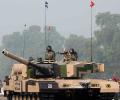
Senior Colonel Liu Degang said the Arjun tank is "very good" and suits Indian conditions.

'The committing of the SFF into operations in Ladakh is a signal from New Delhi of how seriously it takes the Chinese intrusions and the lengths India will go to in combating them.'

Taiwan considers itself a sovereign state -- but China views the self-ruled island as a breakaway province. Beijing has not ruled out the possible use of force to achieve unification.
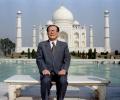
When Jiang Zemin traveled, as you can see in the photographs here, a Kodak Moment was never far away.

'Despite the current tension at Doklam and the risk of escalation on the Himalayan land frontier, it is the Indian Ocean we need to worry about more,' says Nitin Pai.
'This reluctance to respond forcefully to Chinese PLA provocations and outright aggression has as much to do with Prime Minister Modi personally, as with the institutional mindset of the MEA or even the Indian Army.' 'They are scarred by the 1962 War and are still cowed by China.'
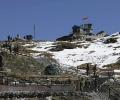
She provided no evidence for the claim, which is at the complete variance with Bhutan's stated position.

This is the first time China-Pakistan began joint patrols in recent years though Chinese troops have been conducting patrols in the area since 2014.

At the young age of 15, Wang joined the People's Liberation Army as a guard.

On December 10, Kissinger began to encourage the Chinese to take action against India: 'If the People's Republic were to consider the situation on the Indian subcontinent a threat to security, and if it took measures to protect its security, the US would oppose efforts of others to interfere with the People's Republic.' On the 50th anniversary of India's greatest military victory, Claude Arpi recalls how the US suggested that China intervene militarily on Pakistan's side.
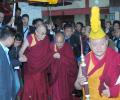
Beijing is clearly rattled by the Dalai Lama's visit. Unlike the 2009 visit, which was a four-day religious tour, the current visit is a high-decibel, 10-day affair, without the fig leaf of a "religious event", reports Ajai Shukla.
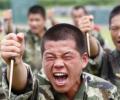
Close on the heels of over a dozen incursions since the face-off in Ladakh in April from across the Line of Actual Control, Chinese troops made a fresh attempt to violate the International Border at Chumar area in north-east of Leh on July 20, but were forced back by Indian troops.
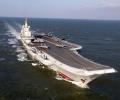
'The Chinese being focussed more seawards is definitely better for India with China being the looming threat along our land borders,' says Brigadier S K Chatterji (retd).
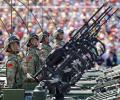
'Whether it is the One Belt One Road project or building relationships in the Indian Ocean Region -- supposedly our area of concern -- the Chinese are seriously outpacing us,' points out Vice-Admiral Premvir Das (retd).

The US election campaign has provided plenty of ammunition for the CCP to make its case that its political system is superior.
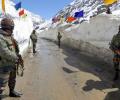
'They cannot use firearms.' 'They have to be restrained.' 'It is a game of patience and chess board moves.' 'It is not like India and Pakistan where bullets get fired and people get killed.'

In its first official account of the standoff between the two militaries, the ITBP revealed how its troops "not only effectively used shield to protect themselves but also responded fiercely to advancing PLA (Chinese People's Liberation Army) troops and brought the situation under control". "The ITBP has recommended the names of 21 men who faced the Chinese during the face-offs and skirmishes in May-June this year for gallantry," it said.
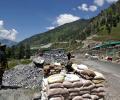
The meeting was attended by National Security Advisor Ajit Doval, Chief of Defence Staff General Bipin Rawat, Army Chief General M M Naravane, Navy Chief Admiral Karambir Singh and Indian Air Force Chief Air Chief Marshal R K S Bhadauria.

The American platforms at the exercise 'Cope India' that started off Kalaikunda will also include a fleet of F-15 E fighter jets, C-130 and C-17 transport aircraft.
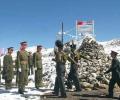
Suddenly the sands are shifting and even friends are acting strange.
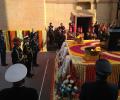
According to convention, Lieutenant General Praveen Bakshi should be named as General Dalbir Singh Suhag's successor as army chief

'China's moves are of direct significance to India, which will closely monitor Chinese naval activity in the Bay of Bengal and the Indian Ocean not least because of Chinese maps depicting claims over the Andaman and Nicobar Islands.'

A group of shepherds were asked to vacate the land by troops of the PLA.

The official cited it as an example of 'how the Chinese military is trying to resolve issues through dialogue mechanisms'.

Prime Minister Manmohan Singh on Sunday left for a five-day visit to Russia and China.

According to official sources, the primary objective of Wei's visit is to deliberate with Indian defence establishment on implementation of decisions taken by Modi and Xi in their informal summit in Wuhan in April.

'The Chinese forces in the narrow Chumbi Valley are currently in the line of sight and fire of Indian forces poised on the ridges along the Sikkim-Tibet border.' 'Aware of this vulnerability, the Chinese have been eyeing the Doklam plateau,' explains national security expert Nitin A Gokhale.

'However, a lot of preparatory work would have to go in and China must be prepared to announce an end to the standoff by disengaging from the remaining areas along the LAC.'

Both sides have completed creation of a buffer zone of three kilometres in the three friction points of Galwan Valley, Gogra and Hot Springs as part of a temporary measure aimed at reducing the possibility of any confrontation.

Former prime minister Jawaharlal Nehru had sought American assistance and wrote to the then US president John F Kennedy to provide India jet fighters to stem the Chinese tide of aggression during the 1962 Sino-India war, according to a new book.

While OnePlus 8 and 8 Pro were launched in April, the devices were not brought into the Indian market given the lockdown.
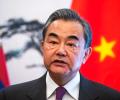
Was Wang Yi'S visit intended to remind India of 1962, asks Claude Arpi?

Chinese President Xi Jinping has stressed the need for the recruitment of new talent to support the rapid modernisation of the armed forces and win future wars amid reports that the military has committed more resources to enrol 3 lakh personnel for frontline positions.
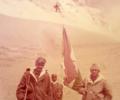
'The Chinese -- up to the highest leadership -- will avoid a conflict because they know they will be badly licked.' 'The reputation they have painstakingly built over the last two-three decades of being a global power will be destroyed.'

'The Fire and Fury Corps is the only formation of the Indian Army and also in the world to have actually deployed mechanised forces in such harsh terrain. The maintenance of the tanks, infantry combat vehicles and heavy guns is a challenge in this terrain. To ensure crew and equipment readiness, adequate arrangements are in place for both man and machine'

The sources also said another round of military talks between the two sides on Wednesday to defuse tensions in the area remained inconclusive. The talks lasted nearly seven hours.

Chinese President Xi Jinping is all set for an unprecedented third five-year term as he was 'elected' to the powerful Central Committee of the ruling Communist Party on Saturday while several top leaders including Premier Li Keqiang have been left out in the major shake-up at the top.
